When your check engine light comes on, your car starts making an unusual noise, or something just doesn’t feel right behind the wheel, it’s natural to wonder what might be going on under the bonnet. The tricky thing is that modern vehicles rely on complex computers and electronic systems, so the cause isn’t always obvious when you try to take a peek for yourself. That’s where a full vehicle diagnostic test can come in handy.
At S.S.C. Mechanics, we’ve been providing car diagnostics in Airport West and the surrounding neighbourhoods for over 12 years. Using industry-standard diagnostic technology, our qualified mechanics can identify fault codes, investigate potential problems, and recommend next steps to get you back on the road safely. Here’s what happens during a car diagnostic scan, what it can reveal, and when it’s worth booking one.
Modern vehicles are designed and built with interconnected systems, so a car diagnostic scan can cover more than just the engine. It can provide a more comprehensive look at what’s going on with your car beyond mechanical repairs. Depending on the vehicle and equipment, checks may include the following:
| What Can a Car Diagnostic Scan Check? | |
|---|---|
| System | What a diagnostic scan can check |
| Engine management systems | Investigate warning lights, performance issues and emissions-related faults. |
| Transmission and gearbox | Identify electronic faults that affect gear changes or transmission operation. |
| ABS and braking systems | Retrieve compatible fault codes relating to anti-lock braking and associated electronics. |
| Suspension and steering electronics | Investigate faults in electronically controlled or assisted systems. |
| Battery, alternator, and electrical systems | Help identify charging-system warnings and relevant electrical faults. |
| Air conditioning and climate control | Check compatible electronic controls and system-related fault codes. |
| Hybrid and EV systems | Assess supported electronic systems using equipment suitable for the particular vehicle. |
NOTE: A scan won’t automatically test every mechanical component or confirm that every system is working correctly. Some issues require physical inspection or specialised testing.
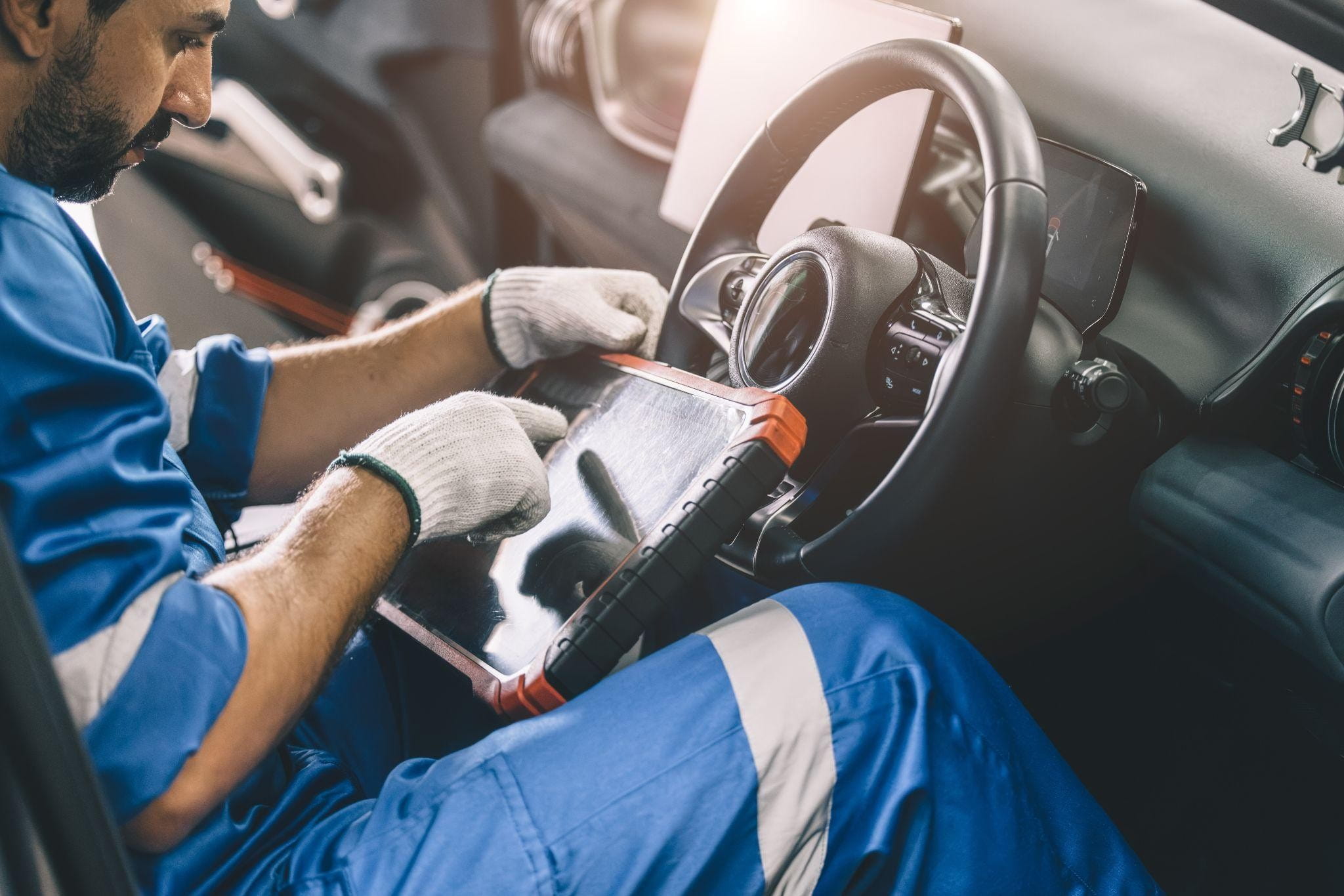
A diagnostic scan connects specialist equipment to your vehicle’s onboard computer system to retrieve information about how it operates. Depending on your car’s make, model, and age, the process may involve several electronic control units, each responsible for a different system. Here’s what happens when you book a full vehicle diagnostic scan.
First, our mechanics connect a diagnostic scanner to your vehicle’s diagnostic port. The scanner communicates with compatible electronic control units to retrieve stored fault codes and other available data. These codes can point to problems involving engine performance, emissions, electrical components, and other vehicle systems.
However, a fault code doesn’t automatically tell us which part needs replacing. Further checks may be needed to identify the underlying cause.
Next, the mechanic reviews the codes and any relevant live data available through the diagnostic equipment. This information can help reveal irregular readings, intermittent faults, or systems that aren’t operating as expected. For example, an engine-related fault code might indicate a problem with a sensor, ignition component, or fuel system.
Our mechanics use the available information alongside their experience to narrow down the possibilities.
Once we identify potential faults, additional testing may be required. This could involve inspecting wiring and connectors, checking electrical components, testing sensors, or performing mechanical checks. The aim is to determine the cause of the symptoms rather than simply replacing parts based on a code.
Once our mechanics have identified an issue, they can explain their findings and recommend repairs.
You don’t have to wait until your car breaks down to arrange a diagnostic check. Even without a warning light, a diagnostic scan may help investigate unexplained symptoms. If you’re concerned about your vehicle, a mechanic can recommend the best starting point, whether a scan, a physical inspection, or another service.
It’s worth contacting a mechanic if you notice any of the following:
For drivers searching for engine diagnostic Melbourne services, early investigation can help identify potential issues before they become more expensive.
No, a diagnostic scan isn’t the same as a regular car service. Diagnostics focus on identifying electronic fault codes and investigating specific symptoms. A regular car service covers scheduled maintenance tasks, which may include oil and filter changes, fluid checks and inspections, depending on the service.
The two can complement each other, though. If a warning light appears during routine maintenance, you may need additional diagnostic testing to determine the cause. A scan can also help before you arrange a broader vehicle inspection in Melbourne, especially if you’re concerned about an unexplained fault.
A diagnostic scan cost depends on the vehicle, the type of fault, and how much investigation is needed. Retrieving fault codes may be relatively straightforward, while tracking down an intermittent electrical problem could require additional testing and workshop time. Check our car service pricing for more information.
If your car needs repairs after testing, ask about the available payment options, including pay later for car repairs.
The time required for a diagnostic scan depends on the vehicle and the complexity of the fault. Retrieving codes may be quick, but investigating the underlying problem can take longer.
The cost of a full vehicle diagnostic scan varies depending on the vehicle and testing required.
Not always. Fault codes help narrow down potential causes, but further testing may be needed to confirm the underlying problem.
A scanner may clear certain fault codes, but that doesn’t fix the underlying problem. Investigate the cause before dismissing the warning.
No, a diagnostic scan investigates electronic faults, while a car service focuses on scheduled maintenance. You may need both, depending on your vehicle’s condition.
A basic OBD scanner can retrieve some engine-related codes, but its capabilities may be limited. Professional equipment can access additional systems on supported vehicles, and a mechanic can interpret the codes.
Not necessarily, but it can be useful if you’re experiencing unexplained symptoms. Some faults don’t trigger a dashboard warning, so further testing may still be worthwhile.
Address a flashing warning light or an unusual change in your car’s performance before it becomes a bigger headache! At S.S.C. Mechanics, our team provides diagnostic services for a wide range of makes and models, from everyday vehicles to European cars. Whether you’re looking for auto diagnostics near me or need help investigating a specific warning light, we’re here to help you understand what’s happening with your vehicle.
Contact us at S.S.C. Mechanics to discuss your concerns and book a diagnostic scan in Airport West today.
BACK TO BLOG
Get In Touch With Us
Fill out this form and one of our friendly team members will get back in touch with you shortly.


 Click to Call Now

 CALL US: