Quick question: when was the last time that you changed your car battery? Do you know? Was it when you purchased your car? Last year? Or maybe, if you drive a secondhand vehicle, that responsibility fell on its previous owner. Do you even know how old your car battery is?
If you’re stumped and it’s really been a while since you last replaced your car’s battery, then you may be in dire need of a new one and may even want to get your car checked by a mechanic. For the sake of your car’s value and your own safety, you may want to consider a car battery replacement service.
If you’re unsure when the best time to replace a car battery is or if you have any questions about them, then you have come to the right place! S.S.C. Mechanics is the expert in all things car battery in the Airport West area!
We’ve written out all the need-to-know details about car batteries and battery replacement, along with the most frequently asked questions about their cost and maintenance.
No matter how often you use your car, how well you look after it, or how expensive the whole thing was, there’s no escaping the reality that no car battery lasts forever. Typically, a car battery can last between three to five years. Of course, this can depend on a variety of factors, like faulty alternators and wiring, extreme temperatures, or even corrosion.
Not every car battery is created equal, though, and some can come equipped with warnings to alert you as your battery reaches its final days. But even if your car battery extends beyond the five-year mark (what a miracle!), then it is still recommended that you make a switch. An older battery can easily fail without any warning, which could put you in an inconvenient and even dangerous position.
Each car battery will act differently, and no two are the same, but there are a few unmistakable signs indicating your battery is looking worse for wear. You may be due for a battery replacement sooner than you expect.
Keep your eyes peeled for any of these situations:
That flashing warning light on your dashboard is not a decoration. Any flashing lights on your car’s dashboard are likely indicating something isn’t working right. If your battery is beginning to operate less efficiently, then the rest of your car will begin to suffer, too. Heed your dashboard’s warning signs… your battery may be about to go.
And if you aren’t sure what the issue could be, then let your mechanic know about your ominous dashboard warning light. They can run a diagnostic test to see what other issues may be plaguing your car.
If your headlights are not shining as brightly as they used to, then it may be time to replace your bulbs. But if that doesn’t fix things, then barring any additional electrical or mechanical issues, your old car battery may be the culprit.
If your battery is struggling to power all the major parts of your vehicle, then your headlights won’t shine as bright. To keep yourself safe while driving on the road at night, consider replacing your battery.
Other electrical issues can point to a dying car battery. Some are obvious, like an inoperable radio or air conditioner.
Some issues may be less noticeable, like your windows. If your windows open and close more slowly than usual, then they may be impacted by your less-than-stellar car battery.
Of course, if your car battery looks like it’s swelling out from the inside, then it is definitely time for a replacement. Driving with a swollen battery is extremely dangerous and can lead to massive problems down the line.
Similarly, a car battery that is covered in corroded battery acid is not ideal. This can lead to increased risk of shorting out, sparking, and even fires in extreme cases.
If you see any of these issues, then consider booking reliable car services near you.
Checking on your car battery is very simple! If you’re worried that your battery is nearing its expiration date, here’s how you can test it yourself at home:
Park somewhere reflective so that you’re able to see your headlights once they’re turned on.
Then, watch your lights as you start your engine. What do you see? Do they strongly dim from their initial brightness? Or perhaps go out almost completely?
If your answer is yes to these questions, then chances are that your battery is on the brink, and it’s time to book in with your mechanic to purchase a battery replacement. Keep your car up to date with regular servicing so as not to fall into the trap of driving with a faulty or failing battery.
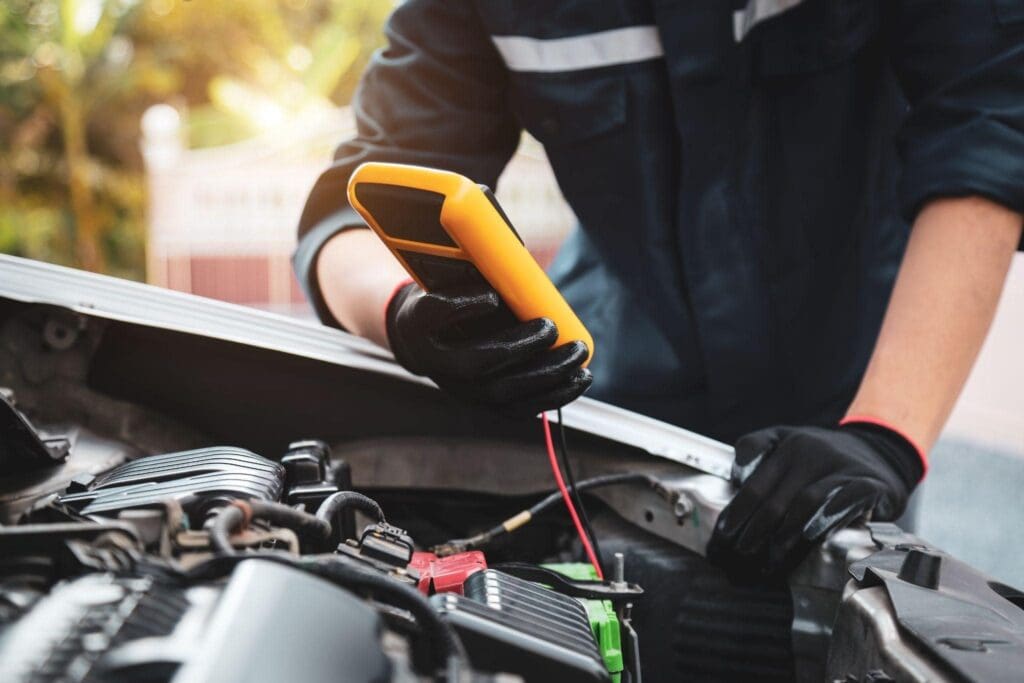
Disconnect the battery from the car’s circuit and connect the multimeter to the battery’s terminals (red probe to the battery’s positive terminal and black probe to the battery’s negative terminal). Then, after a few minutes, take the reading on the multimeter.
If the reading shows a value greater than 7V for a 9V battery, the battery is still fit to use.
But if the reading shows a considerably low value, such as <1V for a 9V battery, then the battery may be faulty and needs to be replaced. A battery is typically considered dead if the multimeter reads below half the voltage level specified on the battery itself.
It’s important to note that Lithium-ion batteries have a limited number of charge cycles and can become damaged if discharged below a certain voltage. It is recommended to consult the manufacturer’s specifications before performing a multimeter test on lithium batteries.
And of course, if you have any questions, then call your local mechanic for expert advice about battery health and safety.
What is it that actually causes your car battery to die? If you use too much energy, then your car battery is likely to drain faster and die more quickly than otherwise. It’s a very simple mistake to make, like the infamous leaving-your-headlights-on-overnight situation.
Other factors include having a battery too old for your newer car, since it can’t adequately handle supplying power to all the technology and accessories. Even extreme and cold weather conditions can weaken the battery’s performance by adding additional strain. This is why it’s important to have regular maintenance checks to ensure the safety and overall performance of your vehicle.
If it looks like the best option for you is to purchase a new car battery, then how much will it actually cost you? There are certain factors that can contribute to a variance in pricing, such as size, voltage, and performance.
The standard price of a car battery can be anywhere between $150 and $350, whereas a premium battery, used in luxury or sports cars, could cost more, between $350 and $650. When you get your car battery replaced by S.S.C. Mechanics, you can rest easy knowing that we only supply quality, first-party batteries with no hidden fees, just competitive, upfront pricing.
Finding a car battery for your vehicle is not a one-size-fits-all task. There are a few factors to consider when choosing the right battery for your vehicle.
Firstly, there will likely be a battery designed for your specific make and model of car. Before buying a new battery, ensure you double-check the owner’s manual to see what the specific specifications for your vehicle are.
Once you’ve cross-checked any specifics you may need, ensure that you see a reputable dealer or mechanic for supplying your battery. Otherwise, you may be left paying for a battery at a higher price that doesn’t go the distance — literally.
You can make sure you get the most distance out of your car battery with a few simple, quality-of-life changes. Keeping these things in mind will help your battery last as long as possible.
Conducting regular servicing and inspections of your vehicle will help ensure you get the most life out of your car battery. When all of your car’s systems are running like they should, then there won’t be any additional strain upon your battery.
Doing this will mean your battery can operate normally and see you through its minimum lifespan.
It is normal for battery acid corrosion to build up occasionally on a car battery. Keeping your terminals and connection points clean from corrosion will help protect the lifespan of your battery. Be sure to check regularly for any buildup and clean it safely as often as you can.
This one may go without saying, but be sure never to leave any electronics running in your car while the engine is off. This includes headlights, dashboard lights, phone chargers, and interior lights.
These smaller devices will draw power from your battery and risk depleting it while the car isn’t even turned on. Do a quick check around the car before leaving to avoid this frustrating mistake.
Extreme heat can add unnecessary strain to your battery and cause it to expand. In the spring and summer months, be sure to park in shaded areas and use sunproof shades in your car to reduce overall heat exposure.
If you live in a warmer climate, then be sure to always keep your car parked in a garage. This will help prevent your battery from overheating and bulging over time.
The benefits of regular battery maintenance and professional servicing are many. Not only will you get the most life out of your battery, but you will also protect your vehicle’s overall battery economy. Preventing undue strain on your car’s systems will keep it safe from bigger issues later on.
Regular battery maintenance and professional servicing are also crucial for commercial and fleet vehicles that use a lot more power. Extensive long-range travel can potentially cause even worse damage to a battery, so regular fleet services are crucial all year long.
The team at S.S.C. Mechanics are well-equipped to perform preventative checks on your car’s battery, ensuring you keep your investment safe at home and on the road. If you have any questions about your car’s battery, then book with us now!
There is no such thing as a bad question when it comes to car battery safety and maintenance. Here are some frequently asked questions our team of battery replacement specialists get all the time.
You can replace a car battery yourself at home, but it is always best to hire a trained professional for car repairs and maintenance to make sure you don’t damage your car’s mechanisms or the battery itself.
Yes, we do! We provide fast mobile battery replacement in Airport West, and we can come to you! Call us for off-site assistance.
We are proud to offer buy now, pay later options for all our battery replacements with Afterpay & zipPay plans.
No matter what kind of car you own, whether it’s a luxury car or a sturdy secondhand one, a car battery is a must-have. At S.S.C. Mechanics, we not only can replace your battery correctly, but we also provide many other premium services, like pre-purchase inspections, repairs, and roadworthy certificates.
So, the next time you need a mechanic in Tullamarine or Essendon or anywhere else in the greater Melbourne area, be sure to book in with an experienced mechanic like ours at S.S.C. Mechanics.
Book online today!
See also: Getting Your Car Ready For Winter: Winter Checklist For Vehicles
Or check out our blog: How To Change A Car Battery
BACK TO BLOG
Get In Touch With Us
Fill out this form and one of our friendly team members will get back in touch with you shortly.


 Click to Call Now

 CALL US: